Fastest sorting network $D(6)$
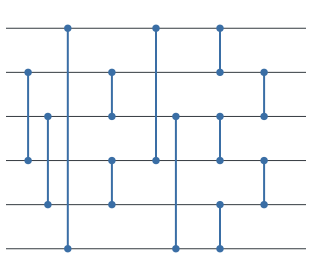
Sorting network on 6 inputs with 12 comparators in 5 steps, drawn as 6 horizontal wires joined by vertical comparators

The smallest depth, or number of parallel steps, of a sorting network on $6$ inputs.

Value: $5$ lower bound Literature upper bound Checked construction

History

Each bound that improved on the earlier ones, with the record of its discovery and its best evidence. A bound is discovered in the literature, or by a certificate submitted here. Its best evidence is a certificate checked here, if there is one at least as strong: a formal proof in Lean (Lean proof) or an explicit construction checked by a program (Checked construction). Otherwise it's an Attested certificate, which someone else checked with a published checker, or the Literature. Submit a certificate.

Date Bound Discovery Best evidence
1968-04-30 $\le 6$ K.E. Batcher, Sorting networks and their applications, AFIPS Spring Joint Computer Conference 32 (1968) 307-314. Checked construction
via $\le 5$, sorting-network-depth-6-upper-5
1973 $\ge 5$ D.E. Knuth, The Art of Computer Programming, Vol. 3: Sorting and Searching, Addison-Wesley, 1973, Section 5.3.4.
[via I. Parberry, A computer-assisted optimal depth lower bound for nine-input sorting networks, Mathematical Systems Theory 24 (1991) 101-116.]
Literature
1973 $\le 5$ D.E. Knuth, The Art of Computer Programming, Vol. 3: Sorting and Searching, Addison-Wesley, 1973, Section 5.3.4.
[via I. Parberry, A computer-assisted optimal depth lower bound for nine-input sorting networks, Mathematical Systems Theory 24 (1991) 101-116.]
Checked construction
Certificate sorting-network-depth-6-upper-5, submitted by daniel-munro, 2026-11-11
[construction from B. Dobbelaere, Smallest and fastest sorting networks for a given number of inputs, https://bertdobbelaere.github.io/sorting_networks.html (page updated 2026-10-10, retrieved 2026-11-11).]

Other certificates

Certificates that aren't the best evidence for any bound above: other certificates are stronger evidence for the same bounds, or they prove only bounds weaker than any recorded.