Lebesgue's universal covering problem
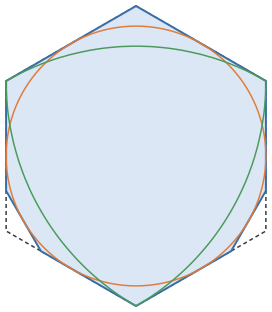
The Lebesgue universal covering constant is the smallest area of a convex set in the plane that contains a congruent copy (by rotations, translations and reflections) of every set of diameter $1$. Pál (1920) showed that a regular hexagon of width $1$ with two corners cut off is such a cover, of area $2 - 2/\sqrt{3}$, and later covers remove more from it.
Lower bound:
$0.833$
Literature
Upper bound:
$0.8440935944$
Literature
History
Each bound that improved on the earlier ones, with the record of its discovery and its best evidence. A bound is discovered in the literature, or by a certificate submitted here. Its best evidence is a certificate checked here, if there is one at least as strong: a formal proof in Lean (Lean proof) or an explicit construction checked by a program (Checked construction). Otherwise it's an Attested certificate, which someone else checked with a published checker, or the Literature. Submit a certificate.