Heilbronn triangle problem in a square $H(8)$
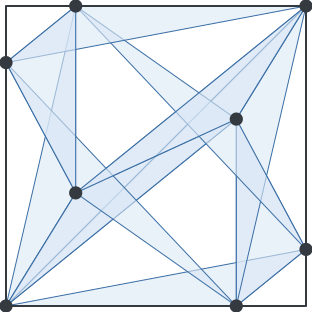
The largest possible area of the smallest triangle formed by three of $8$ points in a unit square.
Value: $\frac{\sqrt{13}-1}{36}$ (≈0.07237642) lower bound Checked construction upper bound Literature
History
Each bound that improved on the earlier ones, with the record of its discovery and its best evidence. A bound is discovered in the literature, or by a certificate submitted here. Its best evidence is a certificate checked here, if there is one at least as strong: a formal proof in Lean (Lean proof) or an explicit construction checked by a program (Checked construction). Otherwise it's an Attested certificate, which someone else checked with a published checker, or the Literature. Submit a certificate.
| Date | Bound | Discovery | Best evidence |
|---|---|---|---|
| 1972-05 | $\ge \frac{2-\sqrt{3}}{4}$ (≈0.0669873) | M. Goldberg, Maximizing the smallest triangle made by N points in a square, Mathematics Magazine 45(3) (1972) 135-144. |
Checked construction
via $\ge 0.07237642431$, heilbronn-square-8-lower-0p07237642431 |
| 2001-10-01 | $\ge \frac{\sqrt{13}-1}{36}$ (≈0.07237642) | F. Comellas and J.L.A. Yebra, New lower bounds for Heilbronn numbers, Electronic Journal of Combinatorics 9 (2002) #R6. |
Checked construction
via $\ge 0.07237642431$, heilbronn-square-8-lower-0p07237642431 |
| 2022-12-28 | $\le \frac{\sqrt{13}-1}{36}$ (≈0.07237642) | L. Dehbi and Z. Zeng, Heilbronn's problem of eight points in the square, Journal of Systems Science and Complexity 35(6) (2022) 2452-2480. | Literature |