Heilbronn triangle problem in a square $H(29)$
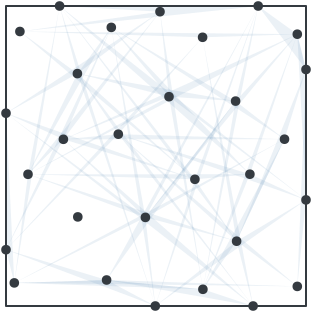
The largest possible area of the smallest triangle formed by three of $29$ points in a unit square.
Lower bound:
${\approx}0.006318902752$
Checked construction
Upper bound:
$\frac{1}{28}$
(≈0.03571429)
Literature
History
Each bound that improved on the earlier ones, with the record of its discovery and its best evidence. A bound is discovered in the literature, or by a certificate submitted here. Its best evidence is a certificate checked here, if there is one at least as strong: a formal proof in Lean (Lean proof) or an explicit construction checked by a program (Checked construction). Otherwise it's an Attested certificate, which someone else checked with a published checker, or the Literature. Submit a certificate.
| Date | Bound | Discovery | Best evidence |
|---|---|---|---|
| 1970-05 | $\le \frac{1}{28}$ (≈0.03571429) | S.H.L. Kung, Problem 745 (A nine point problem), Mathematics Magazine 42 (1969), solution by B.L. Schwartz, Mathematics Magazine 43(3) (1970) 170-171. | Literature |
| 2026-10 | $\ge {\approx}0.006318902752$ |
N. Sudermann-Merx, Heilbronn configurations from a search campaign with basin hopping, ruin-and-recreate moves and seeding from neighboring records (October 2026), as reported in Stead's Heilbronn tables.
[via T. Stead, The Heilbronn problem: square, tables of the best known configurations of n points in the unit square for n = 3 to 100, with their record histories (linked from Erich Friedman's Packing Center), retrieved 2026-11-21.] |
Checked construction
via $\ge 0.006318902752$, heilbronn-square-29-lower-0p006318902752 |