de Bruijn–Newman constant
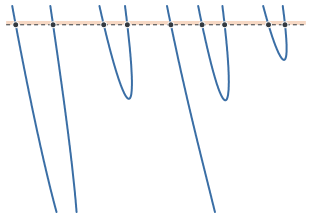
The de Bruijn–Newman constant $\Lambda$ is defined via the zeros of a certain function $H(\lambda,z)$, where $\lambda$ is a real parameter and $z$ is a complex variable. More precisely, $H(\lambda, z):=\int_{0}^{\infty} e^{\lambda u^{2}} \Phi(u) \cos (z u) \, du$, where $\Phi$ is the super-exponentially decaying function $\Phi(u) = \sum_{n=1}^{\infty} (2\pi^2n^4e^{9u}-3\pi n^2 e^{5u} ) e^{-\pi n^2 e^{4u}}$ and $\Lambda$ is the unique real number with the property that $H(\lambda, \cdot)$ has only real zeros if and only if $\lambda\geq \Lambda$. The Riemann hypothesis is equivalent to $\Lambda \le 0$.
Lower bound:
$0$
Literature
Upper bound:
$0.2$
Literature
History
Each bound that improved on the earlier ones, with the record of its discovery and its best evidence.
A bound is discovered in the literature, or by a certificate submitted here.
Its best evidence is a certificate checked here, if there is one at least as strong: a formal proof in Lean (Lean proof) or an explicit construction checked by a program (Checked construction).
Otherwise it's an Attested certificate, which someone else checked with a published checker, or the Literature.
Submit a certificate.
| Date |
Bound |
Discovery |
Best evidence |
| 1950-09 |
$\le 0.5$
|
de Bruijn, N. G. (1950). The roots of trigonometric integrals. Duke Math. J., 17(3), 197-226.
[via de Bruijn-Newman constant - Wikipedia]
|
Literature
|
| 1987-09 |
$\ge -50$
|
Csordas, G., Norfolk, T. S., & Varga, R. S. (1987). A low bound for the de Bruijn-newman constant Λ. Numerische Mathematik, 52, 483-497.
[via de Bruijn-Newman constant - Wikipedia]
|
Literature
|
| 1990-12 |
$\ge -5$
|
te Riele, H. J. (1990). A new lower bound for the de Bruijn-Newman constant. Numerische Mathematik, 58, 661-667.
[via de Bruijn-Newman constant - Wikipedia]
|
Literature
|
| 1991-06 |
$\ge -0.0991$
|
Csordas, G., Ruttan, A., & Varga, R. S. (1991). The Laguerre inequalities with applications to a problem associated with the Riemann hypothesis. Numerical Algorithms, 1(2), 305-329.
[via de Bruijn-Newman constant - Wikipedia]
|
Literature
|
| 1993-12 |
$\ge -5.895 \times 10^{-9}$
(≈-5.895e-09)
|
Csordas, G., Odlyzko, A. M., Smith, W., & Varga, R. S. (1993). A new Lehmer pair of zeros and a new lower bound for the de Bruijn-Newman constant Λ. Electronic Transactions on Numerical Analysis, 1, 104-111.
[via de Bruijn-Newman constant - Wikipedia]
|
Literature
|
| 2000-09 |
$\ge -2.7 \times 10^{-9}$
(≈-2.7e-09)
|
Odlyzko, A. M. (2000). An improved bound for the de Bruijn-Newman constant. Numerical Algorithms, 25, 293-303.
[via de Bruijn-Newman constant - Wikipedia]
|
Literature
|
| 2009-09-10 |
$ \lt 0.5$
|
Ki, H., Kim, Y. O., & Lee, J. (2009). On the de Bruijn-Newman constant. Advances in Mathematics, 222(1), 281-306.
[via de Bruijn-Newman constant - Wikipedia]
|
Literature
|
| 2011-03-09 |
$\ge -1.1 \times 10^{-11}$
(≈-1.1e-11)
|
Saouter, Y., Gourdon, X., & Demichel, P. (2011). An improved lower bound for the de Bruijn-Newman constant. Mathematics of Computation, 80(276), 2281-2287.
[via de Bruijn-Newman constant - Wikipedia]
|
Literature
|
| 2019-08-26 |
$\le 0.22$
|
Polymath, D. H. J. (2019). Effective approximation of heat flow evolution of the Riemann ξ function, and a new upper bound for the de Bruijn-Newman constant. Research in the Mathematical Sciences, 6, 1-67.
[via de Bruijn-Newman constant - Wikipedia]
|
Literature
|
| 2020-04-06 |
$\ge 0$
|
Rodgers, B., & Tao, T. (2020, January). The de Bruijn-Newman constant is non-negative. In Forum of Mathematics, Pi (Vol. 8, p. e6). Cambridge University Press.
[via de Bruijn-Newman constant - Wikipedia]
|
Literature
|
| 2021-01-22 |
$\le 0.2$
|
Platt, D., & Trudgian, T. (2021). The Riemann hypothesis is true up to 3· 10 12. Bulletin of the London Mathematical Society, 53(3), 792-797.
[via de Bruijn-Newman constant - Wikipedia]
|
Literature
|